For New York City co-ops
The super has the keys. The agent has the files. The board has fifteen days.
SmartGrouper keeps a co-op's shareholders, apartments, alterations and the City's deadlines in one place the board can see, with Local Law 58's clock on every application to buy. With a managing agent, or running the building yourselves.
We set up your building by hand, usually within one business day. No card.
With a managing agent, or without one
Running the building yourselves
The board is the office. The maintenance fee, the alterations, the City's deadlines, the staff and the shareholders' questions are in one place, and the next board inherits all of it, not a box of folders.
With a managing agent
Your agent keeps doing what they do. The board gets its own view: what is waiting on it, the deadlines coming up, the alterations and the shareholders' questions. If the board prefers it, maintenance requests go to the agent while the board stays in control, following each one until it is done, with every request kept on record. Name the agent to sign in to DOB NOW for the board, and send them the collections list as a spreadsheet.
It is in a co-op's own words throughout: shareholders, apartments, the maintenance fee, the proprietary lease and alterations. SmartGrouper is for one board and the shareholders it answers to, not a management company's portfolio.
The City's deadlines, worked out for your building
New York City's building deadlines
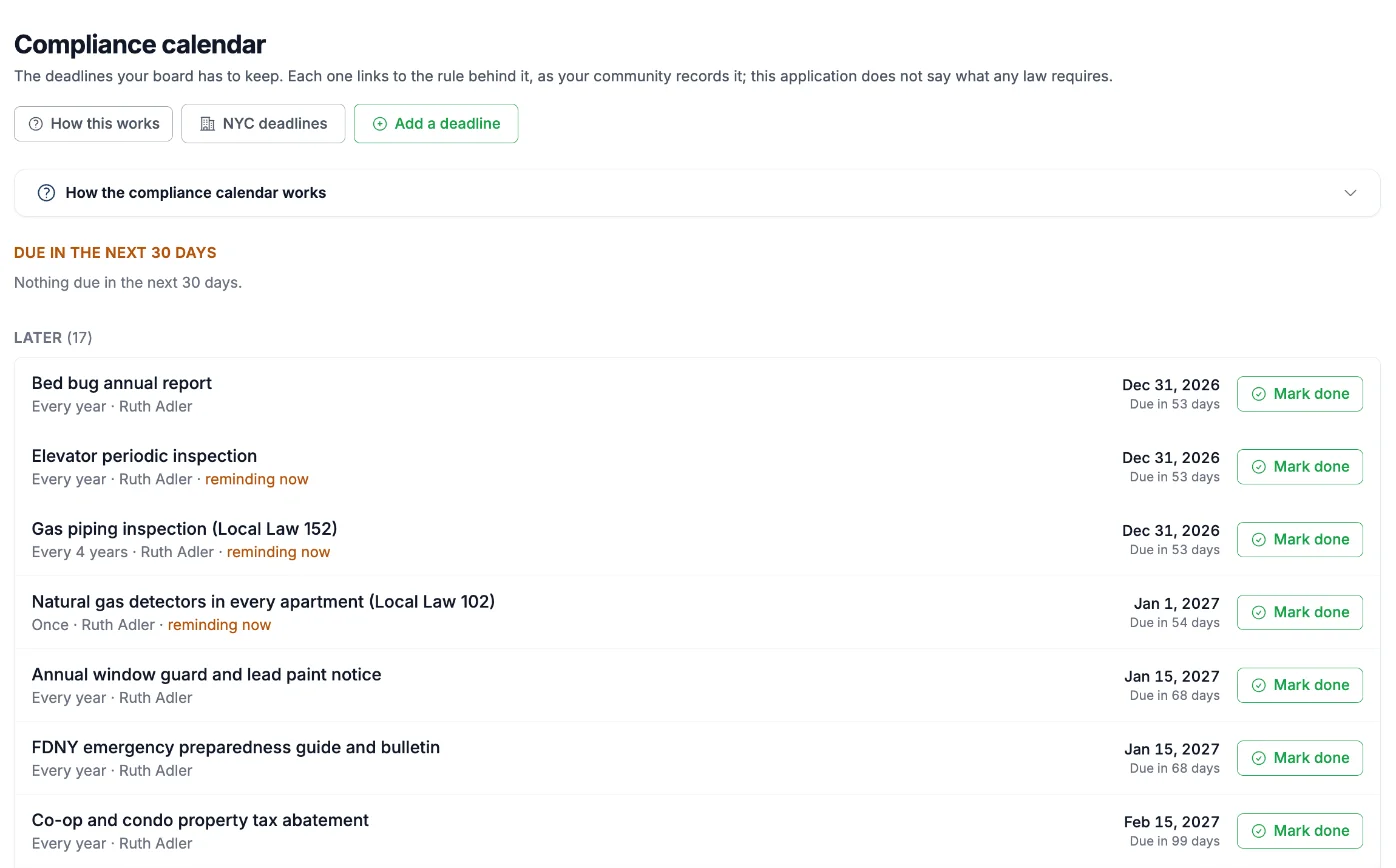
The façade and gas piping inspections, boilers, elevators, Local Laws 84, 97 and 87, the January notices, HPD registration and the co-op tax abatement, with dates worked out from the building's tax block and community district. Tick the ones that apply and each goes on the compliance calendar with a link to the City's own page. Whoever looks after one is emailed as it comes due, and marking it done schedules the next.
The clock on every purchase application
Local Law 58 gives a co-op of 10 or more apartments 15 days to acknowledge what a purchaser sends, and 45 to decide once it is complete. Record who applied and when, and the dates are worked out, with the board's one extension and your summer recess. The acknowledgment is written and emailed for you, you post the registered copy, and you are reminded as each date nears. No financial papers are kept here.
The board's DOB NOW sign-off
The Department of Buildings wants the board's attestation on a shareholder's alteration filing. Say which kinds of work need one and who signs in for the board, a director or your managing agent, then record the day it was done on the City's site. Work under way without one shows on Waiting on you.
The City changes these rules. Each deadline links to the City's own page, and SmartGrouper works out dates; it isn't legal advice. Ask your managing agent, engineer or attorney when you are not sure one applies.
Alterations, from the request to the deposit
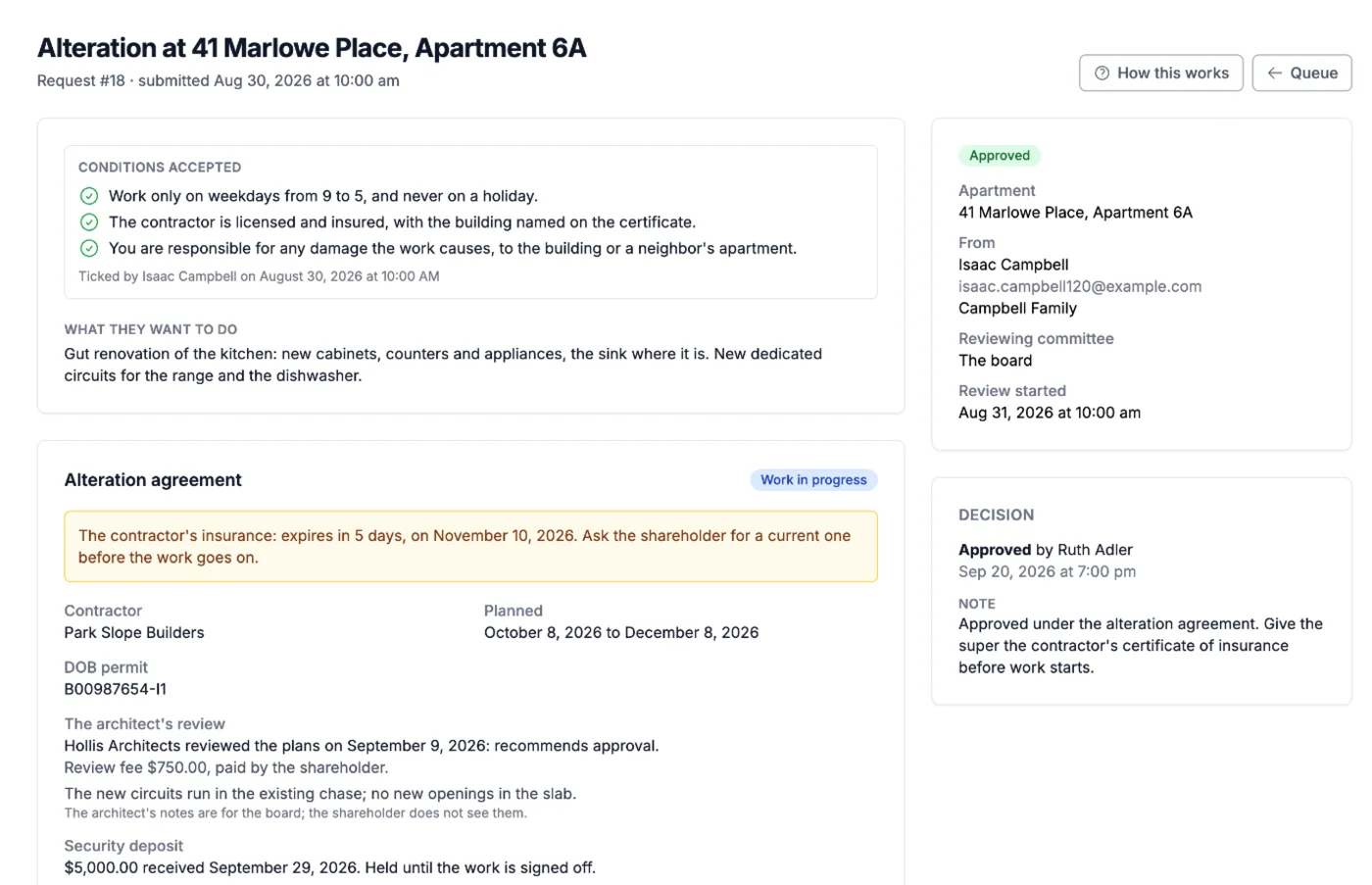
A shareholder asks from their phone, and accepts the conditions for that kind of work first, such as working hours or a ventless dryer. What they accepted is kept word for word in the apartment's file. The board decides, against the house rules.
Then follow the work to the end: the building architect's review and its fee, the security deposit, and the contractor's certificate of insurance naming the corporation and its managing agent, with a warning before it runs out. Email the apartments above, below and beside with the dates and the contractor. At sign-off the shareholder is emailed, with what happens to the deposit.
The building, by the share
Every apartment, its shares and who lives there, the money that follows from them, and the repairs that keep the building running.
Shares, and costs split by them
Each apartment's shares from the offering plan, 1,250 of 25,000, and the monthly charge and any special assessment split by them. Buildings lists the apartments still missing theirs.
The maintenance fee, by the share
Bill every apartment at a rate per share, as a total split by shares, or as a percentage change from last time, and each bill says how it was worked out: 300 shares at $4.25 a share. October's fee covers October, whichever day it goes out.
The stock certificate and the lease
Each apartment's stock certificate number and its proprietary lease. When an apartment sells, the buyers' new ones are recorded, and the sellers' are kept with their past ownership.
Who to call, and who may be let in
A resident file for every apartment: who lives there, emergency contacts, the lender, parking, storage, keys and pets, printed per apartment or as one spreadsheet. Shareholders keep their own details up to date, and nothing goes on file until the board approves it.
Repairs, and the super
Residents report a problem from their phone, with photos. The super or the handyman gets a login of their own that shows only the work given to them. Trends show what is rising and where it repeats: one apartment, a line of apartments, the building.
One elevator, not fifteen reports
The board shares a common-area problem with every resident. They see the board already has it, press “This affects me too” instead of reporting it again, and are emailed when it is fixed.
A notice under every door
Mark the households that get notices on paper. For each email the board sends, print a delivery checklist by apartment, a copy for each of those households, and a large-type notice for the lobby.
Collections, for your counsel
Every apartment behind on its payments, the oldest debt first, with its shareholders and how to reach them. Download it as a spreadsheet for the managing agent or your attorney, and switch on late fees when you are ready.
Who works for the building
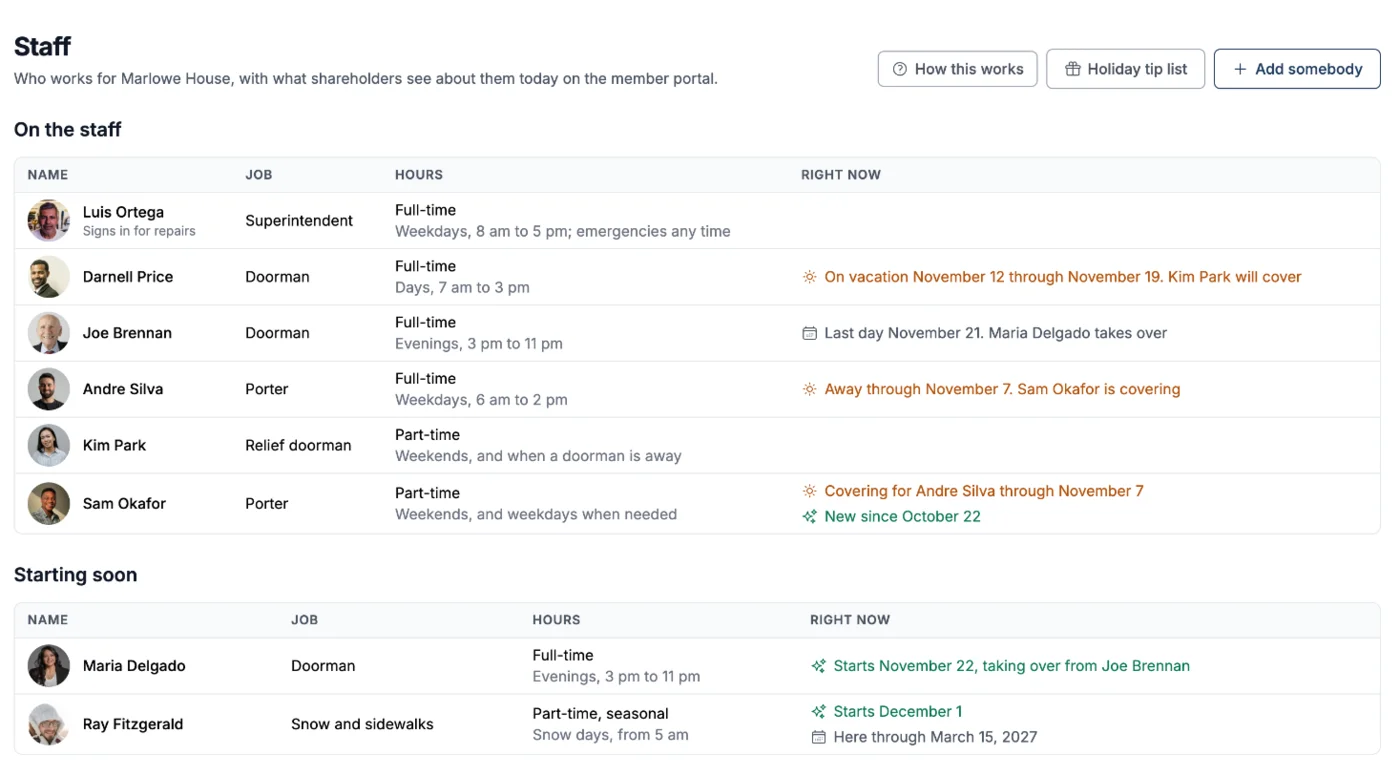
The super, the doormen and the porters, each with a photo, their job and their hours. Shareholders look it up and see who is new, who is leaving, who is on vacation and who is covering. Introduce somebody new with one email to every resident.
At the holidays, the board's suggested tips go by job and years of service, with its note on how to give and by when.
For shareholders
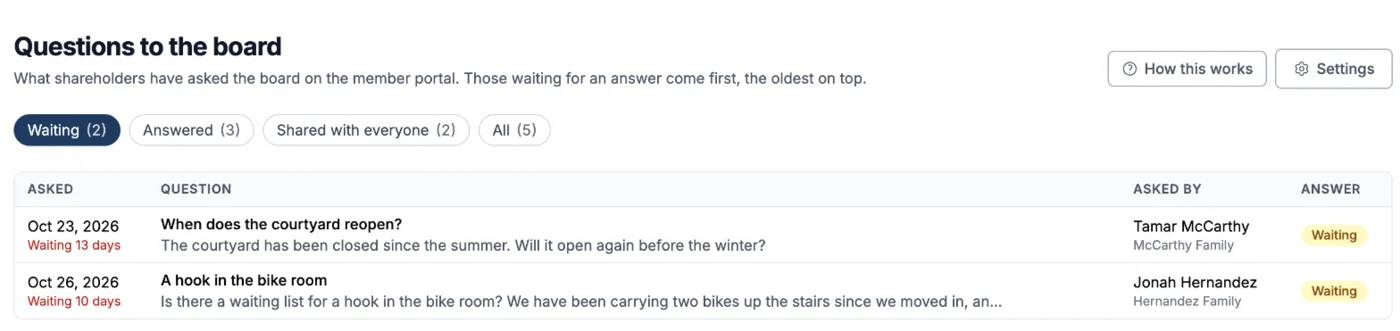
Every shareholder gets a simple site that works on any phone, under the corporation's name, never ours. What they do there, from paying to asking a question, reaches the board straight away.
The rest of what a board does
The budget and the reserves, the bank statement matched, projects with their special assessments, contractors and their insurance, votes run by the book, board seats and terms, and a hand-over page for when a director steps down. It is all on the page for HOAs, condos and co-ops.
Not yet
Votes and director elections counted by shares, with proxies; reviewing buyer and sublet packages, which stay with your agent or BoardPackager; sending the extension notice and the decision on a purchase application, which the board sends and records; electronic signatures; text messages; and reading in a management company's monthly statements. If your board needs one of them, tell us.
One flat price for the whole building
Set by how many apartments the corporation has, not charged per apartment, with every feature in every plan and no cut of shareholders' payments. Pay for the year and it costs 15% less. The one extra, if you want it, is AI.
Up to 10 apartments
$19a month
A brownstone or a small walk-up.
11–50 apartments
$39a month
A walk-up or a small elevator building.
51–150 apartments
$79a month
A larger building with a full-time staff.
151–300 apartments
$129a month
A big building, still run by its own board.
301–500 apartments
$179a month
A very large building, or several.
Over 500 apartments
Let's talk
A complex of buildings under one corporation.
There is no Free plan. Every building starts with a free trial that we set up by hand, with no card. See how the plans work
“SmartGrouper made the whole process of managing a small condominium so much easier, especially being able to accept online payments and tracking our expenses.”
Start with your own building
Tell us about your co-op and we will set up a site for it, usually within one business day, with a co-op's features already switched on. No card. We can bring in your shareholders from a spreadsheet for you.
Your managing agent is welcome
Bring them into the trial. They can see what the board sees, and tell us what would make their side of the work easier.